بەها:
{"id":7046,"name":"Judgment Under Uncertainty: Heuristics and Biases","slug":"judgment-under-uncertainty","date_created":{"date":"2026-02-18 21:44:15.000000","timezone_type":3,"timezone":"Asia\/Baghdad"},"date_modified":{"date":"2026-02-18 21:45:26.000000","timezone_type":3,"timezone":"Asia\/Baghdad"},"status":"publish","featured":false,"catalog_visibility":"visible","description":"
About The Humankind<\/h2>\r\n A Hopeful History presents a bold reinterpretation of human nature, questioning the widespread belief that people are selfish and driven mainly by competition. Drawing on history, psychology, and real-world case studies, Rutger Bregman revisits famous experiments, historical events, and cultural assumptions that have shaped modern views of humanity.<\/p>\r\n
The book argues that cooperation, trust, and kindness have been central to human survival and success. Bregman explores how institutions, media narratives, and social structures often reinforce cynical views of human behavior, while evidence suggests a more hopeful reality. Combining storytelling with research, Humankind<\/em> offers a compelling case for rethinking society, education, and leadership based on trust in human potential.<\/p>\r\n
About the Author Rutger Bregman<\/h2>\r\n Rutger Bregman is a Dutch historian, writer, and public intellectual known for his work on social progress, inequality, and human nature. He has written widely on history, economics, and social change, gaining international recognition for presenting optimistic, evidence-based perspectives on society.<\/p>\r\n
Bregman\u2019s work often challenges conventional thinking about human behavior and the future of social systems. Through his writing and public speaking, he advocates for policies and ideas grounded in trust, cooperation, and long-term thinking, making him one of the most prominent contemporary voices on hopeful social change.<\/p>\r\n\r\n
\u0628\u06d5\u0633\u062a\u06d5\u0631\u06d5\u06a9\u0627\u0646\u06cc \u062f\u0627\u0628\u06d5\u0632\u0627\u0646\u062f\u0646\u06cc \u067e\u06d5\u0631\u062a\u0648\u06a9<\/h3>\r\n\u0641\u0627\u06cc\u0644\u06cc PDF\r\n\u0641\u0627\u06cc\u0644\r\n\u0631\u0627\u06cc\u06af\u0627\u0646<\/h3>\r\n<\/video>","short_description":"\r\n
\r\n
\r\n
\r\n
\r\n
\r\n
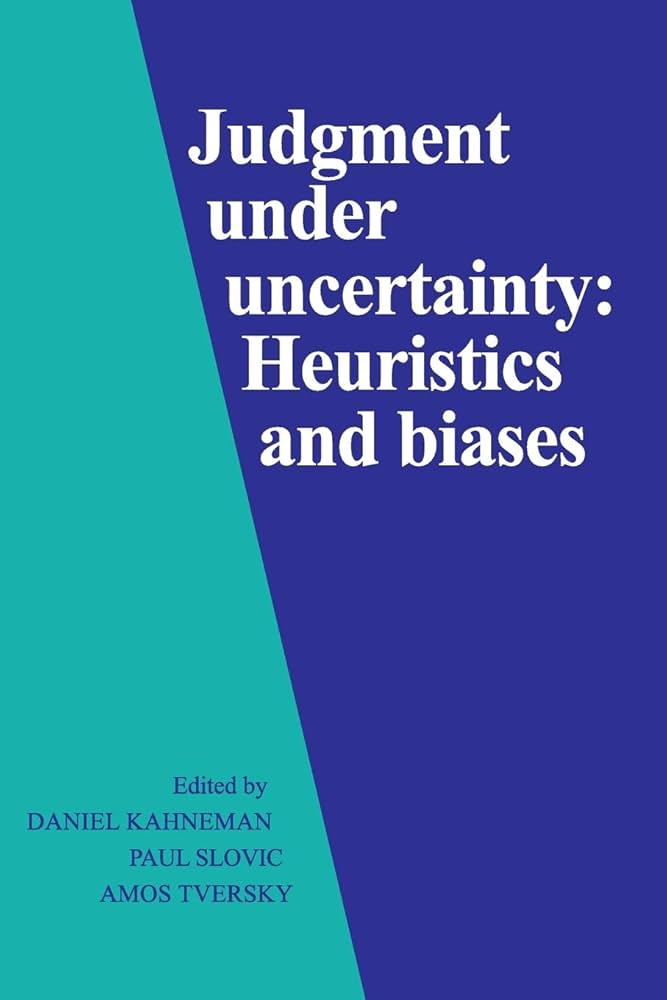
Judgment Under Uncertainty<\/h2>\r\n Judgment Under Uncertainty: Heuristics and Biases<\/span><\/span> is a landmark collection of research showing how people rely on mental shortcuts when making decisions under uncertainty\u2014and how these heuristics often lead to systematic biases in judgment.<\/p>\r\n\r\n<\/div>\r\n<\/div>\r\n<\/div>\r\n<\/div>\r\n<\/div>\r\n<\/div>","sku":"","global_unique_id":"","price":"0","regular_price":"0","sale_price":"","date_on_sale_from":null,"date_on_sale_to":null,"total_sales":1,"tax_status":"taxable","tax_class":"","manage_stock":false,"stock_quantity":null,"stock_status":"instock","backorders":"no","low_stock_amount":"","sold_individually":false,"weight":"","length":"","width":"","height":"","upsell_ids":[],"cross_sell_ids":[],"parent_id":0,"reviews_allowed":true,"purchase_note":"","attributes":[],"default_attributes":[],"menu_order":0,"post_password":"","virtual":true,"downloadable":true,"category_ids":[76],"tag_ids":[],"brand_ids":[],"shipping_class_id":0,"downloads":{"c94ece47-4f71-44c1-b4b5-68227282961c":{}},"image_id":"7064","gallery_image_ids":[],"download_limit":-1,"download_expiry":-1,"rating_counts":[],"average_rating":"0","review_count":0,"cogs_value":null,"meta_data":[{"id":58063,"key":"_wp_page_template","value":"default"},{"id":58064,"key":"pweb_metabox","value":{"learnpd-userpanel":"1","video-preview-link":"","video-preview-cover":"","students-course":"","progress-course":"75","prerequisite-course":"","item-course":"","selected-items":"","pd-preview":"https:\/\/pishtaz-web.com","pdsell-count":"","item-pd":[{"item-text":"\u0646\u0633\u062e\u0647 \u0645\u062d\u0635\u0648\u0644","item-response":"1.8.3","item-icon":"fas fa-pager"}]}},{"id":58067,"key":"_elementor_edit_mode","value":"builder"},{"id":58068,"key":"_elementor_template_type","value":"product-post"},{"id":58069,"key":"_elementor_version","value":"3.35.5"},{"id":58070,"key":"_elementor_pro_version","value":"3.35.1"},{"id":58071,"key":"_elementor_data","value":"[{\"id\":\"30602ea\",\"elType\":\"section\",\"settings\":{\"css_classes\":\"content-collapse\",\"ha_cmc_text\":\"Happy Addons\"},\"elements\":[{\"id\":\"4328257\",\"elType\":\"column\",\"settings\":{\"_column_size\":\"100\",\"_inline_size\":null,\"ha_cmc_text\":\"Happy Addons\"},\"elements\":[{\"id\":\"34bf8cd\",\"elType\":\"widget\",\"settings\":{\"editor\":\"About The Judgment Under Uncertainty<\\\/h2> This influential volume brings together pioneering research by Daniel Kahneman<\\\/span><\\\/span>, Paul Slovic<\\\/span><\\\/span>, and Amos Tversky<\\\/span><\\\/span> on how humans evaluate probability, risk, and uncertainty. The book introduces key cognitive heuristics\\u2014such as representativeness, availability, and anchoring\\u2014that people use to simplify complex decisions.<\\\/p>Through experimental findings and theoretical analysis, the authors demonstrate that these mental shortcuts, while useful, frequently produce predictable errors in reasoning. The work transformed psychology, economics, and decision science by revealing the systematic patterns behind human judgment. Widely regarded as a foundational text in behavioral science, the book remains essential for understanding how people think, decide, and assess risk<\\\/p>
\\u00a0<\\\/p>
About the Authors<\\\/h2> Daniel Kahneman<\\\/strong> was an Israeli-American psychologist and Nobel Prize\\u2013winning economist whose work on heuristics and biases helped found behavioral economics.<\\\/p>Paul Slovic<\\\/strong> is an American psychologist known for his research on risk perception, decision-making, and public understanding of uncertainty.<\\\/p>Amos Tversky<\\\/strong> was an Israeli cognitive psychologist whose groundbreaking collaboration with Kahneman reshaped modern understanding of judgment and decision-making.<\\\/p>\",\"column_gap\":{\"unit\":\"px\",\"size\":\"0\",\"sizes\":[]},\"ha_advanced_tooltip_content\":\"I am a tooltip\",\"ha_cmc_text\":\"Happy Addons\"},\"elements\":[],\"widgetType\":\"text-editor\"}],\"isInner\":false}],\"isInner\":false},{\"id\":\"5c11af4\",\"elType\":\"section\",\"settings\":{\"ha_cmc_text\":\"Happy Addons\"},\"elements\":[{\"id\":\"a638148\",\"elType\":\"column\",\"settings\":{\"_column_size\":\"100\",\"_inline_size\":null,\"ha_cmc_text\":\"Happy Addons\"},\"elements\":[{\"id\":\"24306bf\",\"elType\":\"widget\",\"settings\":{\"lessons-part-icon\":{\"value\":\"fas fa-book-open\",\"library\":\"fa-solid\"},\"lessons-part-title\":\"\\u0628\\u06d5\\u0633\\u062a\\u06d5\\u0631\\u06d5\\u06a9\\u0627\\u0646\\u06cc \\u062f\\u0627\\u0628\\u06d5\\u0632\\u0627\\u0646\\u062f\\u0646\\u06cc \\u067e\\u06d5\\u0631\\u062a\\u0648\\u06a9\",\"lessons_list\":[{\"lesson_title\":\"\\u0641\\u0627\\u06cc\\u0644\\u06cc PDF\",\"lesson_icon\":{\"value\":\"far fa-file-pdf\",\"library\":\"fa-regular\"},\"lesson_label\":\"file\",\"lesson_content\":\"






 <\/p>\r\n\r\n
 \r\n\r\n